Breaking Down Set Pieces: Picks, Packs, Stacks and More

Set pieces occupy an uncanny spot in football. They constitute such a sizeable part of the sport, yet most matchgoers and viewers could be forgiven for glazing over them when they come around. Often it can be hard to discern what the attacking team’s plan is, what to be on the look out for or if a plan even exists to begin with. They seem to be underestimated as a tool in the minds of both the supporter and those working within the game. Being armed with an understanding of the base concepts at play can bring a whole lot of clarity to what often seems like a mess of moving players, as well as spark ideas on how more could be done with this slice of the game.

It all starts with identifying the setup of the defensive team and what can be done to exploit it to the attacking team’s advantage. Fundamental to this in the vast majority of set piece situations is the orientation of the defenders. All defenders in all marking schemes – be they man or zonal – are forced to track two things simultaneously: the delivery of the ball and the movement of the attacking players. Immediately this becomes a clear avenue to go at. Look at the defenders (Hoffenheim, the team in blue) on this example:

You’ve got a whole grab bag of them lined up across the six-yard box. A couple of the attacking team, Freiburg, are positioned either behind them or out of their peripheral vision to the side. The defenders can check over their shoulders all they like but at some point they’re going to have to turn to judge the flight of the ball, at which point they’ll lose track of what’s going on. And one poor sucker in particular is going to suffer because of it:

Yer man at the near post, no.14, has no clue what’s coming. These kinds of lapses are as common as Lonnie Rashid Lynn himself – it seems like an easy header until it isn’t. There’s a predilection amongst many football commentators to be suspicious of zonal marking, questioning it when it goes wrong while rarely doing the same of man-to-man marking. This has lead to a reaction in many people online, countering by pointing out man marking’s many failings when they crop up. The truth is that zonal systems are just as fallible if attacked correctly by making it as hard as possible on the defender’s player-tracking skills.

It’s also fun to see how various coaches do this. Ole Gunnar Solskjær (and/or members of his staff) have taken some rather extreme approaches. Both at home with Molde and in the new job.

This is all partially why one might prefer near post deliveries on corners. They give you a chance to attack in front of the defence, off of their blindside. Far post deliveries are useable too of course, but have more obvious flaws. Attacking behind the defence sounds nice, but the extra time the ball spends in the air gives them (and the goalkeeper) more time to react to its flight and move to block or intercept. They work best in tandem with physical mismatches or distractions, which we’ll come to.

All of these orientation ideas apply equally on free kicks too of course, where deliveries to the far side have more room to work. Check out this nifty one, with three attackers stationed on the far side of the defensive line creating a bit of an overload, putting doubt in the defenders’ minds before one of the attackers makes a delicious last second run to intercept the ball. Vision cones! It’s like Metal Gear Solid all over again.

Oh and they also apply on… whisper it… throw ins.

There’s a sampling of how to mess with zonal marking schemes… How to screw with man marking then? Well this is where we get to inject a little spice into a set piece routine by using the physical presence of players to disorganize the opposition’s marking. The simplest version of this is a ‘pick‘ (or ‘screen’), a concept that originates from basketball. The idea is that a player stands still in order to create an obstacle that must be navigated around. An obstruction for some poor unsuspecting soul. Like so:

These are used to free up teammates, to create space between them and their defender. The above example is off the cuff as part of regular play. But of course these are used in all sorts of clever and aesthetically pleasing routines. Watch the bottom side of the court (the weakside in basketball parlance, away from the action) on this one:

While everybody’s attention is being diverted towards the player(s) on the ball, a shooter is peeling off to the corner and his teammate is setting a pick on his defender. Boom, open three-point shot. Nice and simple.

Pick plays can offer the exact same utility in football. They’re somewhat more frowned upon by referees in this sport, but so are a thousand other things that don’t get penalised. In open play there isn’t much of an opportunity to use them – the pitch is just too big (although don’t let that stop you creative sorts from trying). On set pieces, within the confined spaces that corners, close free kicks and long throws take place, they can be deadly. Just ask Christian Maggio here.

Or no.22 getting a dose of Czech-on-Czech action.

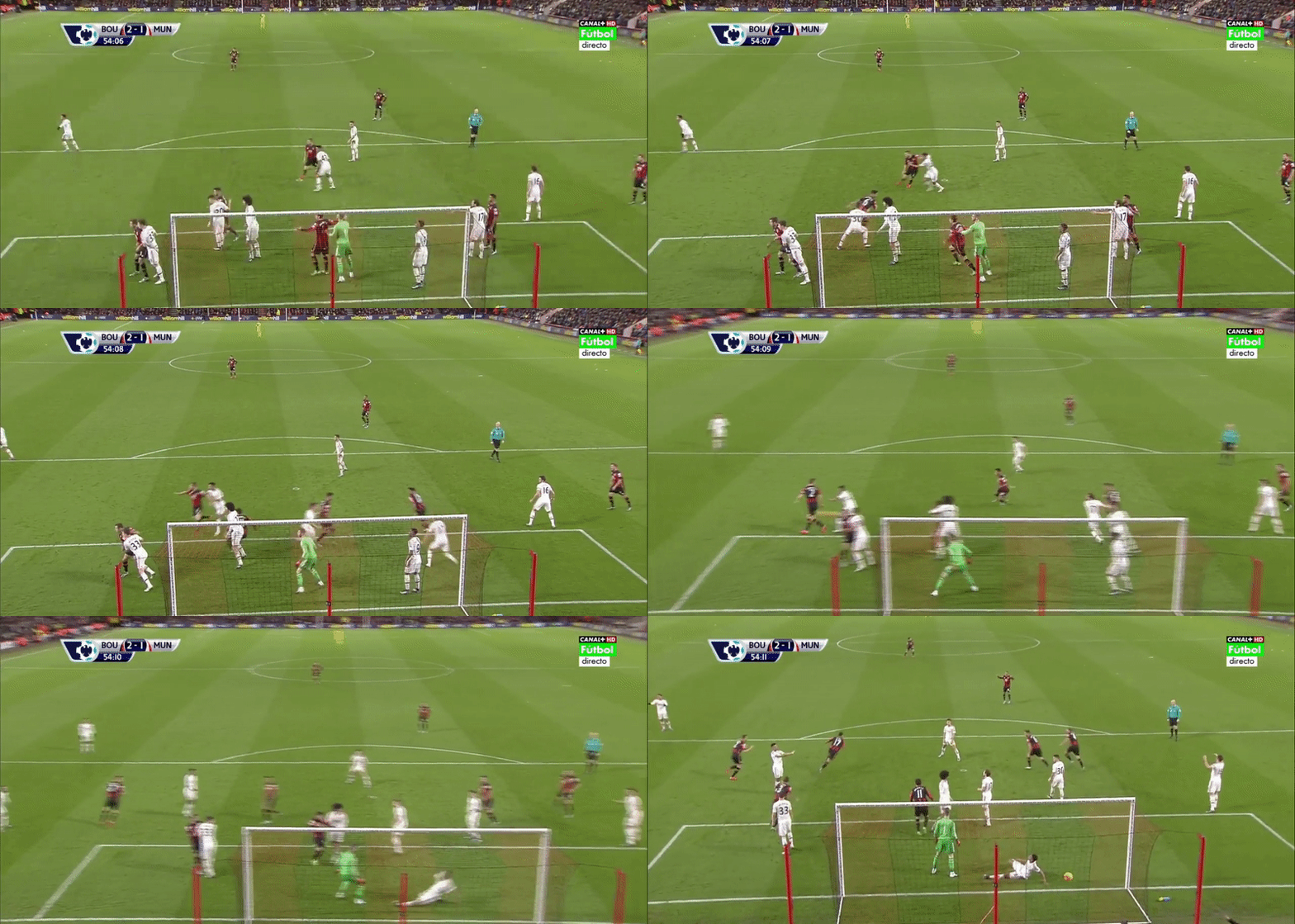
Or this unfortunate Dutch fellow wearing no.17 and his big friend with the equally sizeable afro. These two were merely trying to ply their trade for a plucky northern English club and this happens to them? Terrible, but word is that they both went on to make appearances in the latter stages of some notable football tournaments, a redemption tale we can all take heart from.
If you allow yourself a dalliance with the inventive bits of your brain, then you can surely imagine all the ways that a pick can be used. It’s generally advised to keep routines simple. The more actions of a high degree of difficulty that you ask a player to complete as part of the sequence of events, the more opportunities for the whole affair to break down at some point.

These sorts of plays are ripe for causing misdirection. On this corner, Thun (in red and white) initially play it short and it isn’t clear what their plan is. All the defenders are orientated towards the action. The real target is positioned all the way behind them on the other side of the box, in their blindside. The only defender who sees what’s coming is his marker, and he is the victim of a great pick that stops him from intervening (it’s also worth noting that this possibly illegal pick is slyly done out of sight of the referee as well). A secondary defender at the top of the six-yard box is also blocked off to prevent him getting involved.

While picks are still effective in football, the box is of course larger than half of a basketball court. Thus finding ways to shrink the space and make it harder for defenders to get around is of great help.

Dealing with picks presents real problems for defenders. Do you go over the obstacle? Under? Or is there a different option? In Basketball there’s a defensive scheme called ‘switching‘. This is something you’ll have seen in football – even in open play – but likely not under these terms. It’s essentially when one defender passes off the man they’re marking to another. They are ‘switching’ their defensive responsibilities with one another. If you’d like to read more there’s an excellent ol’ article on the subject on Cleaning the Glass.

Here’s an example in football, as Sparta Prague (the team in the burgundy kit) execute a switch in the bottom corner of the box.

This has its upsides, but also its obvious downsides. The first of which is mismatches. If a larger player who is being defended by a similarly big fella sets the pick for a smaller (and usually quicker) teammate, and the defenders execute a switch, then you have a slow lumbering person matched up a smaller one who can zoom past them. (And of course the smaller player’s likely small defender will also now be matched up against someone who is taller and/stronger more imposing than them). Voila, now you have a mismatch. Applying the same principles, this can be achieved in football too.

In the first clip of this example, a variety of screens and movement forces a smaller defender with shorter arms onto a player who is able to grab the ball from out of his reach and get a relatively simple layup. In the Ajax case, a smaller defender switches onto Matthijs de Ligt (no.4), who outmuscles his new marker with ease (Ajax loved this routine during De Light’s time there, using it with much success).

The other defensive quandary this causes is miscommunication. Defenders have to be on their tippy-toes both physically and mentally to deal with picks in this manner. If they slack for one second, or don’t communicate well enough one with each other, then breakdowns occur. You don’t even strictly need picks to accomplish this. Any contrasting movement of attacking players in close spaces puts the same sort of pressure on the defence. Here are a couple new examples, with little annotations this time, as it can be tricky to take in everything going on in real time.

One quirk of football relative to basketball is that we can bunch a lot of players together in one space, and then instruct them to make their runs from there. In this situation the defenders again have to communicate as they cant get handsy with or even close to this swarm of attackers before they shoot off like buzzing bees in every which direction. Liverpool showed a great use of this in their recent match against Newcastle, completely discombobulating the home team’s defence freeing up van Dijk. We call these ‘packs‘.

The cousin to the pack is the ‘stack‘. Instead of bunching together in one set piece wrecking ball, the attackers form into a straight line. This has similar disruptive effects.

The ideal marking setup is some hybrid of zonal and man. That way the man marking side can slow the attackers down before they reach the zonal markers. But packs and stacks, and a combination of all the concepts we’ve discussed here can wreak havoc on most defensive schemes when done correctly.

______________________________________________________________________________

That’s enough ground to cover for now. There’s all sorts of other areas to explore of course – more on throw-ins, free kicks (direct and indirect) and so on. Hopefully, this overview has provided some food for thought. It’s enjoyable to watch matches and be on the look out for these quirks. Or to be mildly miffed when your favourite team isn’t employing them.

Thanks for reading.

Atlético Madrid’s Ailing Attack

It should really never be understated how impressive Diego Simeone’s tenure at Atlético Madrid has been. To maintain, across many years, a high degree of relevance – both domestically and on the European scene – is excruciatingly difficult in football. They’ve established themselves as clearly the third best team in La Liga, something that sounds like a backhanded compliment but really isn’t given the two juggernauts above them. Sure, they haven’t been especially close to winning the title since the year they achieved it but, again: Barcelona and Real Madrid.

This season though, things are starting to look a little dicey. It should be noted first off that there are a handful of slight concerns on the defensive site. Atléti are allowing a higher proportion of the opposition’s completed passes in their own final 18 yards – a measure they previously dominated – as well as allowing higher completion percentages than usual in zones closer to goal. Really though, these are pretty marginal and could easily be early season noise. The overall defensive numbers are fine. It’s on the other side of the ball where the clearest issues lie.

atleti compari

Defensive efficacy has always been Atléti’s bread and butter but you don’t maintain their level of competitive relevance without also having a potent attack. The drop off in this respect is sharp. 41% of their shots came from outside the box last season, that’s up to 50% this season (2nd highest % in the league). Where’s this stemming from then? A large portion of it can be found in their transition game. When you defend in a compact, relatively deep shape it’s imperative that you can break out and counter, lest you just spend the entire match defending. This season they’re struggling with that.

own half.png

Similarly, there’s been a chunk shaved off the opportunities they get from turnovers closer to the opposition goal. Generating shots from winning the ball in these areas has never been a primary source for them, but they’ve squeezed bits out of it all the same. 

Rplot12

Overall the speed just isn’t quite there.

1200

If you give them the ball and treat them like a possession side they’re not so hot either. Last season they had the 8th most possessions that lasted 10 passes or longer, and the 6th most shots from those possessions. This season those numbers are just about the same: the 9th most of these possessions overall and also 9th in terms of shots from them. This would be fine production if the transition side were functioning as normal. It’s two flawed sides of the same coin right now.

plot_zoom_png.png copy.png

Simeone’s a smart cookie. He’ll recognise all of this of course and has more than enough wherewithal to turn things around. It’s just that this is starting to feel like a lost season for the club. They’re already out of the Champions League at the group stages – barring some unlikely results – and their spot as Spain’s third best is under threat from a wildly improved Valencia (big love to my lad Marcelino). They’ll probably be fine come the season’s end, but for their first season in the new stadium (and possibly Simeone’s last in Madrid?) it’s all a bit anticlimactic.

__________________

Thanks you very much for taking the time out to give this a read. You can find me on Twitter @EuanDewar. Enjoy the week’s football!

The Premier League’s Top Six vs Everyone Else

The Premier League’s top six teams are, as you’ll have no doubt noted, quite good. The upper end of the table is so thoroughly packed with quality now that, even though Arsenal improved on their points tally from last season by five points, they ended up finishing 5th as opposed 2nd in 2015-16. For the big boys it’s a question of how many points you can avoid dropping in silly circumstances on your way to a title challenge or a European football spot.

Yet there’s also something in it for the 14 other teams who push back against the elite, only to end up getting steamrolled more often than not. If you can game plan correctly and get an unexpected win or draw it could be huge in the battle against other relegation strugglers. Or for those treading water in midtable it could be key in an attempt to enter into the league’s upper echelon.

Now that the season is over we can take a look back at who got the most out of these matches. We’ll pick through the more interesting of these in a moment but first lets get you those juicy overall tables.

Premier League Top Six In Matches Against Non-Top Six Teams:

P W D L GF GA GD Pts
Chelsea 28 25 2 1 69 19 +50 77
Tottenham 28 22 5 1 73 16 +57 71
Manchester City 28 21 5 2 69 24 +45 68
Arsenal 28 21 3 4 62 26 +36 66
Manchester United 28 16 11 1 47 17 +30 59
Liverpool 28 17 5 6 62 33 +29 56

Rest of the Premier League In Matches against the Top Six:

P W D L GF GA GD Pts
Everton 12 2 4 6 14 23 -9 10
Crystal Palace 12 3 0 9 11 22 -11 9
Leicester 12 2 2 8 12 30 -18 8
West Brom 12 1 2 9 6 21 -15 5
Burnley 12 1 2 9 8 19 -11 5
Bournemouth 12 1 4 7 13 31 -18 7
Swansea 12 1 2 9 13 32 -19 5
West Ham 12 1 2 9 10 31 -21 5
Hull 12 1 1 10 6 32 -26 4
Southampton 12 0 4 8 6 22 -16 4
Watford 12 1 0 11 11 36 -25 3
Middlesbrough 12 0 3 9 7 23 -16 3
Stoke 12 0 3 9 10 33 -23 3
Sunderland 12 0 2 10 6 27 -21 2

Chelsea vs Tottenham

To win a title you need to be good enough to do so and you need a variety of things to go your way. Season after season the team who wins the PL has this combination of quality and luck, and Tottenham had that in 2016-17. The fantastic ability of their players and how well-drilled they are in Pochettino’s style is self-evident. On top of it all though Hugo Llloris posted the league’s highest save% (76.2%) and they had the second largest overperformance on their expected goals for (per ObjectiveFootball). They squeezed every last drop out of their season, as James Yorke put it.

There was, however, one respect in which they were spectacularly unlucky: They had this season at the same time Chelsea were having an even better one. To put this into perspective, here’s how many total points each PL winner dating back to 2010-11 gained from matches against non top-six teams: 67, 70, 67, 75, 65, 63. Tottenham’s tally of 71 is, by all rights, an obscene number. It just happened to fall behind a much more obscene one.

Big Sam’s Big Return:

Allardyce took over as manager of Crystal Palace on the 23rd of December 2016, with Palace sitting a point above the relegation zone. They only managed to scrape four points from their first eight matches under him, but so bad were the teams around them that at the end of those eight matches they were still a point above the drop. Yet many people considered them a major favourite for relegation. Why? At the time they had only played six of their unfortunately mandatory 12 matches against the PL’s top six. Surely strength of schedule would be too much to overcome.

Then, out of nowhere, they won three in a row against top six teams. A run that immediately jettisoned them to the second best record in such matches, and kept them there for the remainder of the season despite losing the rest. These weren’t lucky breaks either. The 2-1 win away at Chelsea was a bit so-so, but they matched Liverpool at Anfield and deservedly beat Arsenal at home. No team should expect to do well against the dominant teams, but if you can just do better than those around you it can make a huge difference come the end of the season.

Manchester United’s Home Woes:

Make no bones about it: there were times this season where Mourinho was a little too Mourinho. His ‘don’t lose as a priority’ tactics occasionally hurt United more than it helped, especially in matches against fellow top six teams. Yet for every match where they got what they deserved, they had one that looked like this:

This is the kind of errant luck that produced many of those 11 draws against non-top six teams, eight of which were at home. Mike Goodman wrote a great article going over this in detail that you should give a read. The overall point though is that if even just a handful of these matches swung their way the narrative on United would be wildly different, and Mourinho wouldn’t have to be sweating winning the Europa League to avoid not qualifying for the Champions League.

Stoke

This is something that has been said previously on this blog but it bears repeating in this roundup: You have to do better against the top six than Stoke did this season if you consider yourself a candidate to leapfrog other midtable sides into the group of clubs looking at a Europa League spot. Again, no one does overwhelmingly great in these matches. That doesn’t excuse Stoke getting humbled over and over in them, conceding more goals than the team who finished bottom of the table.

Their highest home attendance of the season was a 4-0 loss to Tottenham. The second of three 4-0 thumpings in a row that Spurs have handed them. For the love of god, give your supporters some respite.

Liverpool

On the other side of the ‘you have to do better’ divide lies a dishevelled Liverpool. They were undefeated against other top six teams this season, winning five and drawing the rest. There’s no real question that they’re as good as those around them, but it didn’t stop them frequently dropping points elsewhere in stupid circumstances.

Six Losses against the rest of the league were characterised by sterile play in possession and bewildering mistakes in defence. If you’re Jürgen Klopp there’s no question about what needs to be improved upon next season to avoid dropping out of the title race prematurely (if you are actually Jürgen Klopp, thanks for reading. The beard is looking good mate).

Stoke: Pottering About

As the curtain slowly comes down on the 2016-17 season, so too does it mark the end of Mark Hughes’ fourth season in charge of Stoke.  This one has in many ways been identical to the three that proceeded it. Despite that, however, it has presented some genuinely interesting questions about what the club does next. But before we get all existential lets set out the stall on how Stoke have looked under Hughes.

The greatest consternation about Stoke has been centred around their attack. Hughes inherited a club that had just spent seven years with Tony Pulis, the sultan of functional and effective, as its manager. Therefore the assumption, fair or not, was that Hughes would push them on beyond that and into something more stimulating. The reality is though that they’ve been about as ho-hum as it gets.

Screen Shot 2017-05-14 at 14.11.52

Stoke under Mark Hughes (Penalties removed)

The idea most supporters have of Stoke being the same every season is borne out in the numbers. With the exception of an aberrational 2014-15 season their production has never been anything more than serviceable. That 14-15 shots tally was good for the 9th best in the league but otherwise they’ve always floated around 14th. There does seem to have been an increased focus on better quality shots this season as shown in their % of shots outside the box and xG per shot. Without an improvement in their overall output though it hasn’t been enough to be meaningful.

One of the stranger aspects of Stoke under Hughes has been their record against the top 6. You’ve no doubt at some point heard a pundit or commentator claim that Stoke ‘make it tough’ for the big teams. There is some truth in the cliche but as ever it’s more complicated than that. No one should be expected to have a good record against the big sides. They’re too dominating for that. But as a midtable team one way you can keep your supporters’ interest is by at least making those matches interesting. Stoke do that… sometimes.

Screen Shot 2017-05-14 at 14.45.43

Stoke’s record against the top 6 under Mark Hughes

In Hughes’ first three seasons they had a habit of picking up good wins; who could forget that last match of the season 6-1 drubbing of Liverpool in Steven Gerrard’s final appearance? But when Stoke get beat they often get beat hard. 14 of their 28 losses against the top 6 have been by three or more goals. This season the bottom has completely dropped out to an embarrassing extent and Tottenham beating them 4-0 has now become routine. Even Arsenal, who hadn’t beaten Stoke away since the 2009-10 season, managed to put that particular ghost to rest.

And what of the much vaunted recruitment? Players have been brought in from far and wide seemingly with the intention of aiding the transition from Pulisball to something more attractive. Well that hasn’t really panned out either.

The striker role has been in particular disarray. Bojan was brought in from Barcelona but he has never been a shots monster, producing 2.4/1.9/1.9 shots p90 since joining in 14-15 and now has been shifted out on loan to Mainz. Wilfried Bony was brought in on loan from the wilderness of Manchester and has posted their best shot tally this season (2.7 p90) but has only played 690 minutes. Saido Berahino has been a non-factor, playing similarly few minutes and only putting up 1.6 shots p90. Mame Biram Diouf is even worse at 0.9 shots.

Xherdan Shaqiri hasn’t been as effective a creator as a he was pre-Stoke (3.5 key passes p90 at Inter) but he doesn’t have much around him to work with and has produced a respectable 2.1/2.2 KP p90 in the last two seasons (although he still takes too many shots from outside the box). Joe Allen chipped in with a few goals early but now has scored just two since October, has two assists all season (both in one game) and is producing an iffy 1.2 shots/0.9KP p90. Then you have all these players like Ibrahim Afellay, Ramadan Sobhi, Julien Ngoy and Giannelli Imbula who have played fewer minutes combined than 33-year-old Glen Whelan has on his own.

In fact, this season Mark Hughes has just turned back to all the old boys. Outside of the Allen/Arnautovic/Shaqiri triumvirate their most featured non-defenders have been Whelan, Charlie Adam, Diouf, Jonathan Walters and Peter Crouch. The whole ‘Stokealona’ idea died before it even got off the ground.

So now Stoke sit, heading into the summer with a squad full of players that either don’t contribute or the manager doesn’t seem to like, along with a bunch of older ones that he does seem to like but aren’t very good and, again, are old. They’ll likely break their three season streak of finishing 9th but without ever having actually flirted with relegation. Mark Hughes has created the quintessential midtable team.

Whether he is still manager at the start of next season all depends on one question: What do the club’s owners want? Are they content to float from season to season, soaking in the Premier League money? Or will they gamble on of the newer names currently without a job, with the chance of pushing them out of the malaise? Or perhaps they’ll just bring in John Terry and run it all back again.

Hertha Berlin’s Away Struggles

C-l7IQLXcAAj8Kt

As most of German football has trended towards a high energy style focused on pressing and quick transitions, Hertha Berlin have essentially ‘gone acoustic’. Watch just one half of football from them and you’ll get the gist. An extremely slow and safe game with lots of very purposeful sideways passing along their defensive line, progressing up the pitch at a snail’s pace. For as excruciating as it can be to watch at times, it has, in fairness, brought success. Last season they finished 7th in the Bundesliga, and at the time of writing they’re sitting 6th in this season’s table, just a point off 5th.

There is one catch though. They are terrible away from home. Their home record this season is 12 wins, 1 draw and 3 losses with a goal difference of +13. Good for the 5th best home record in the league. All lovely. Their away record is 2 wins, 3 draws and 11 losses with a goal difference of -15. Which makes for joint-2nd worst away record in the league. At home they’re a Europa League side, away from it they’re somehow relegation fodder.

At home Hertha create 11.8 shots per game. Not a great number, but when you consider their intentionally slow pace and the fact only 35% of those shots come from outside the box (5th fewest in the league), you can see why it works. They limit opponents to an average 12.1 shots with 42% of them coming from outside the box. They also block the 3rd highest amount of shots per game in the league. And that’s the game plan: play it safe, get pretty good shots and don’t give up any great ones. Simple.

The problem is that the plan just doesn’t work on the road. Away from home they create an abysmal 7.9 shots. Not only is that the worst in the Bundesliga, it’s the 4th worst across Europe’s top 5 leagues. It’s also not like this offensive impotence comes with any defensive benefit. They give up 13.3 shots away from home with only 34% of those coming from outside the box, all this alongside a drop off in terms of shots blocked.

Things get even uglier when you bring their expected goals* production into it. Hertha, like their Bundesliga peers Gladbach, have been a slightly tough side to appraise via xG due to the combination of their odd style of play plus a high amount of blocked shots. Even so, the signs aren’t good. In 16 away matches they’ve managed to have the better of the xG tally just three times. Two of those three opponents – Wolfsburg and Augsburg – are in the bottom three of Bundesliga home records and are currently fighting off relegation.

Hilariously (depending on your perspective) they complete an identical amount of passes both home and away: 77%, on a similarly close amount of passes. It’s abundantly clear that they need to switch it up when travelling because home teams just aren’t falling for their schtick.

All credit to manager Pál Dárdai for the work he has done creating a solid home team. It’s looking likely that the home record will bring them Europa League qualification and their highest league finish since 2009. The away record, however, is unacceptable.

*All expected goals numbers in this piece are sourced from FiveThirtyEight.